Campus ERP vs Traditional Student Management: Why Private Universities Are Making the Switch
There's a moment every university registrar knows too well. It's the end of the semester, and the finance team is reconciling fees in one system, the academics team is processing results in another, the admissions team is tracking new inquiries in a spreadsheet, and no one has a clear picture of how many students are actually on track to graduate. Three systems, four spreadsheets, and a prayer.
This is what happens when an institution outgrows its traditional student management approach but hasn't yet adopted a campus ERP. And increasingly, private universities are recognising that the gap isn't just inconvenient — it's actively costing them students, revenue, and competitive position.
First, Let's Define Our Terms
The terminology in education technology can be confusing. "Student Information System," "Student Management System," "Campus ERP," "Academic ERP" — these terms are often used interchangeably, but they represent different levels of capability. Understanding the distinction is essential for making the right technology decision.
Traditional Student Management Systems
A traditional student management system (or Student Information System) is designed to manage core student data: records, enrolment, grades, and basic reporting. Think of it as a digital filing cabinet for student information. Early-generation SIS platforms were on-premise, single-function tools that did one job — storing student records — and did it adequately.
The problem? Universities don't just store records. They recruit students, collect fees, schedule classes, manage lecturers, track attendance, generate transcripts, produce regulatory reports, and a hundred other things. A traditional SIS handles a fraction of this and forces the institution to bolt on additional tools — or resort to spreadsheets — for everything else.
Campus ERP
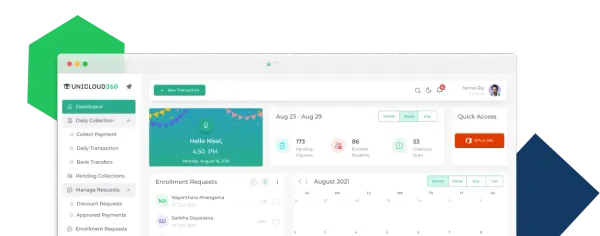
A Campus ERP (Enterprise Resource Planning) system takes a fundamentally different approach. Rather than managing student data in isolation, a campus ERP integrates all institutional functions — admissions, academics, finance, IT management, lecturer operations, student self-service, and reporting — into a single, unified platform.
The "ERP" part is key. In the corporate world, ERP systems (like SAP and Oracle) became dominant because they eliminated data silos and gave organisations a single source of truth. A campus ERP applies the same principle to higher education: one platform, one database, one view of every student, every payment, every class, every interaction.
Academic ERP
"Academic ERP" is a subset of campus ERP that focuses specifically on academic operations — course management, timetabling, assessments, progression, transcripts. In practice, most modern campus ERP platforms include robust academic ERP functionality as a core module rather than selling it separately.
The Problem with Traditional Student Management
To understand why private universities are switching, you need to understand what traditional student management actually looks like in practice:
Disconnected Data
The admissions team uses a CRM (or a shared Google Sheet). The registrar uses a legacy SIS. The finance team uses accounting software. The lecturers use a separate portal — or email. None of these systems talk to each other. When the vice chancellor asks, "How many students enrolled this intake, how many have paid, and what's our dropout risk?" — no one can answer without hours of manual data compilation.
Manual Processes Everywhere
Student registration involves printing forms, collecting signatures, manually entering data into multiple systems, and filing paper copies. Payment reconciliation requires downloading bank statements and matching them line-by-line against the fee system. Attendance is tracked in paper registers and manually transcribed. Every manual step introduces delay, error, and cost.
No Real-Time Visibility
Traditional systems produce reports — eventually. End-of-semester summaries, quarterly financial reports, annual enrolment analyses. By the time decision-makers see the data, the opportunity to act on it has often passed. A student who stopped attending three weeks ago? You'll find out at the end of the term. A counsellor who hasn't followed up on 40 inquiries? You'll discover it next month.
Scaling Breaks Everything
A system that works for 200 students rarely works for 2,000. As private universities grow — adding programmes, opening branches, entering new markets — traditional systems buckle. Data inconsistencies multiply, manual processes become bottlenecks, and the IT team spends more time fighting fires than enabling innovation.
Poor Student Experience
Today's students grew up with Amazon, Uber, and Instagram. They expect a smooth, intuitive, digital-first experience from their university. When they can't check their fee balance online, can't see their assessment deadlines in a dashboard, can't get a receipt without visiting the finance office — they notice. And they compare. And in a competitive private education market, those comparisons matter.
What a Campus ERP Actually Looks Like in Practice
A modern campus ERP transforms these fragmented, manual operations into an integrated, automated workflow. Here's what that looks like across the student lifecycle:
Inquiry to Enrolment (Counsellor Module)
When a prospective student inquires — via website, phone, walk-in, or education fair — the inquiry is automatically captured in the system. A counsellor is assigned. Follow-up tasks are generated. The counsellor tracks every interaction, and management can see real-time conversion rates, pipeline metrics, and team performance against recruitment targets.
When the student decides to enrol, the registration process flows directly from the inquiry record — no re-entry of data, no paper forms, no gaps.
Academic Operations (Academic Module)
The academic team builds a General Academic Plan that defines programme structures, course sequences, and assessment frameworks. Classes are scheduled, lecturers are assigned, and students are automatically enrolled into the correct sessions. Rescheduling, additional classes, repeat management, and course transfers are all handled within the system.
Transcripts and certificates? Generated automatically based on the academic record — not manually compiled from multiple spreadsheets.
Financial Management (Finance Module)
When a student enrols, their fee structure is automatically created based on their programme, intake, and any applicable discounts or scholarships. Payment plans are generated. Payment reminders are automated. Online payment options — including payment gateway integration — allow students to pay from anywhere.
On the back end, reconciliation happens automatically. Multi-currency handling supports international students. Government loan scheme integrations handle subsidised students. And the finance team has a real-time view of collections, outstanding balances, and revenue forecasts.
Lecturer Experience (Lecturer Module)
Lecturers access a streamlined interface to manage assessment marks, record attendance (including QR code and biometric options), and handle class scheduling changes. They don't need to learn complex enterprise software — the platform gives them exactly the tools they need, nothing more.
Student Self-Service (Student Module)
Students log in to a personalised dashboard showing their academic progress, upcoming assessment deadlines, payment status, and attendance records. They can access everything they need without visiting the registrar's office, the finance counter, or the IT helpdesk.
IT Administration (ITM Module)
User provisioning, role-based access control, student ID card generation, branch management, and system configuration are centralised in an IT management module. Premium reporting powered by AWS QuickSight gives leadership dynamic, interactive dashboards.
Institutional Reporting (Reports Module)
Standard and dynamic reports cover every functional area — enrolment trends, financial performance, academic outcomes, attendance patterns, counsellor productivity. Reports can be generated on demand, scheduled automatically, or explored interactively through business intelligence tools.
Campus ERP vs Traditional SMS: The Head-to-Head Comparison
| Dimension | Traditional SMS | Campus ERP |
|---|---|---|
| Scope | Student records and basic academics | Full institutional operations |
| Data | Siloed across multiple systems | Single source of truth |
| Processes | Manual, paper-heavy | Automated workflows |
| Visibility | Retrospective reports | Real-time dashboards |
| Student experience | Transactional, office-dependent | Self-service, digital-first |
| Scalability | Breaks with growth | Elastic, multi-campus ready |
| Integration | Bolt-on tools, custom bridges | Native, built-in modules |
| Finance | Separate system required | Integrated fee management |
| Admissions | Spreadsheets or separate CRM | Built-in counsellor and inquiry management |
| Cost | Low initial, high hidden costs | Predictable SaaS subscription |
| Deployment | On-premise (usually) | Cloud-native (AWS, etc.) |
Why Private Universities Are Making the Switch Now
Several converging forces are accelerating the transition from traditional student management to campus ERP:
1. Post-Pandemic Digital Expectations
COVID-19 forced universities to digitise overnight. Students and staff who experienced fully digital operations during lockdowns now refuse to go back to paper-based processes. The institutions that hadn't invested in digital infrastructure are scrambling to catch up.
2. Intensifying Competition for Students
In markets like South Asia, Southeast Asia, and the Middle East, the number of private HEIs is growing faster than the student population. Institutions compete on experience, speed, and professionalism. A modern campus ERP is no longer a competitive advantage — it's table stakes.
3. Regulatory Pressure
Government regulatory bodies are increasing their reporting requirements. Institutions need to produce detailed data on enrolments, completion rates, financial management, and academic standards — often at short notice. A campus ERP makes this trivially easy; a collection of disconnected systems makes it a scramble.
4. The Affordability Inflection
Five years ago, campus ERP was synonymous with enterprise platforms like Salesforce Education Cloud or SAP — systems with six-figure implementation costs and complexity designed for large research universities. Today, purpose-built platforms like UniCloud360 offer comprehensive campus ERP capabilities at a fraction of the cost, with implementation timelines measured in weeks rather than months.
For a private university with 300–500 students, a modern campus ERP like UniCloud360 starts at $249/month plus a one-time $3,000 implementation fee — a total first-year investment that's less than many institutions spend on manual data entry labor alone.
5. Cloud Infrastructure Maturity
AWS, Azure, and Google Cloud have made enterprise-grade hosting accessible, affordable, and globally available. A campus ERP hosted on AWS delivers the same reliability, security, and performance whether your institution is in Colombo, Dubai, Nairobi, or Singapore.
Common Concerns — and How They're Addressed
"Our processes are unique. Can an ERP accommodate that?"
Modern campus ERPs offer customisation — both through configuration (setting up your specific programmes, fee structures, and workflows) and through custom development when needed. UniCloud360, for example, offers system customisation at $20/hour for institution-specific requirements.
"Data migration sounds terrifying."
It's not trivial, but it's manageable. Reputable vendors scope data migration as a dedicated workstream, with developer effort estimated per engagement. The key is choosing a vendor with migration experience in your region and institutional type.
"What about training? We have staff who aren't tech-savvy."
The best vendors include comprehensive training as part of implementation. UniCloud360 includes 10 initial training sessions (40 hours) along with video tutorials and user manuals. Additional training is available on-demand.
"Is it secure enough for student data?"
Cloud-based campus ERPs hosted on AWS are typically more secure than on-premise server rooms. Look for vendors with ISO certifications — ISO 9001 for quality management (which UniCloud360 holds) and ISO 27001 for information security (which UniCloud360 is currently pursuing).
How to Evaluate a Campus ERP for Your Institution
If you're considering the switch from traditional student management to a campus ERP, here's a practical evaluation framework:
- Map your lifecycle — Does the platform cover inquiry, admissions, academics, finance, lecturers, student self-service, and reporting?
- Check integration depth — Are modules natively integrated, or bolted together?
- Assess scalability — Can it handle your 5-year growth plan?
- Evaluate the vendor — How many institutions do they serve? Are they certified? Are they funded for long-term viability?
- Compare total cost — Include implementation, training, customisation, and migration — not just the monthly fee
- Request a demo — See it with your own data scenarios, not just a canned presentation
Conclusion: The Switch Isn't a Question of If
The trajectory is clear. Private universities are moving from disconnected, traditional student management systems to integrated campus ERPs — and the early adopters are already reaping the benefits of better data, smoother operations, and stronger competitive positioning.
The question isn't whether your institution needs a campus ERP. It's whether you'll be leading the transition — or catching up to competitors who already have.