5 Signs Your University Needs a Modern Student Management System

No institution wakes up one morning and suddenly realises its systems are broken. It happens gradually. A workaround here, a spreadsheet there, a process that used to take an hour now takes a day. By the time the pain is obvious, the institution has been losing efficiency — and often students — for months or years.
The challenge is recognising the signs early, before fragmented systems cause real damage. If any of the following five scenarios sound familiar, your university has likely outgrown its current student management approach — and a modern student management system isn't a luxury. It's urgent.
Sign 1: Your Staff Spend More Time on Data Entry Than on Students
Here's a question that reveals more than any audit: What percentage of your administrative staff's time is spent entering, re-entering, or reconciling data across different systems?
If the answer is anything above 20%, your systems are failing you.
What this looks like in practice:
- A student registers, and their personal details are manually entered into the admissions system, then re-entered into the academic system, then re-entered into the finance system
- Attendance data is collected on paper in the classroom, then manually transcribed into a spreadsheet, then manually compiled into a report at the end of the month
- When a student's phone number changes, it needs to be updated in three or four separate systems — and it's updated in two of them, forgotten in the others
- End-of-semester reporting requires staff to download data from multiple sources, copy-paste into a master spreadsheet, and manually check for inconsistencies
What a modern SMS does differently:
A single, integrated student management system eliminates redundant data entry entirely. When a student registers, their profile is created once and flows automatically to every module — academics, finance, IT, student self-service. When a phone number is updated, it's updated everywhere. When attendance is recorded (via QR scan or biometric tap), it's immediately available in reports — no transcription, no compilation, no delay.
The time your staff currently spend fighting data should be spent supporting students. That shift alone often justifies the transition.
Sign 2: You Can't Answer Basic Questions Without a Spreadsheet
Imagine your vice chancellor walks into your office and asks three simple questions:
- "How many students enrolled this intake compared to last year?"
- "What's our fee collection rate this month?"
- "Which programmes have the highest dropout rates?"
If answering any of these questions requires opening a spreadsheet, sending an email to another department, or scheduling a meeting — your systems aren't giving you the visibility you need.
What this looks like in practice:
- The registrar has enrolment numbers, but they don't match what the finance team shows because they count differently
- Fee collection data lives in the accounting software, which isn't connected to the student database, so "collection rate" requires manual calculation
- Dropout data requires comparing this semester's roster to last semester's, manually identifying who's missing, then checking with academics whether they're on leave, transferred, or actually dropped out
- Every leadership meeting starts with 30 minutes of "let me pull that data" followed by "these numbers might not be exact"
What a modern SMS does differently:
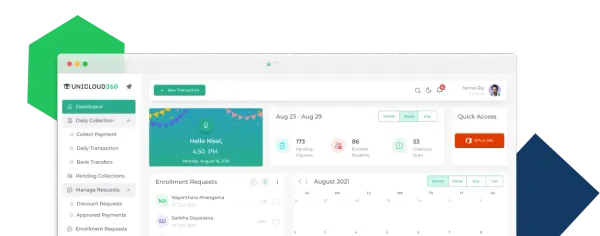
A modern student management system with integrated reporting gives leadership real-time dashboards. Enrolment numbers are current as of this minute. Fee collection rates are calculated automatically and updated with every transaction. Student progression and dropout metrics are tracked continuously, with at-risk students flagged proactively.
The difference between "I'll get back to you next week with those numbers" and "Let me pull up the dashboard right now" is the difference between reactive and strategic institutional management.
Sign 3: Your Admissions Process Loses Prospective Students
For every private university, the admissions funnel is the revenue pipeline. And if you're honest about your current process, you probably know there are leaks.
What this looks like in practice:
- Inquiries come in through multiple channels — website forms, phone calls, walk-ins, education fairs — and there's no single system tracking all of them
- Counsellors manage their follow-ups in personal notebooks, email folders, or individual spreadsheets. Management has no visibility into who's been contacted, who hasn't, and what's in the pipeline.
- A prospective student who inquired three weeks ago and never heard back has already enrolled at a competitor. No one noticed because the inquiry was logged on a sticky note that fell behind a desk.
- When a student does decide to enrol, the registration process involves printing forms, collecting physical signatures, and manually entering data that the counsellor already collected during the inquiry stage
- There's no way to measure conversion rates, counsellor performance, or the effectiveness of different recruitment channels because the data doesn't exist in any structured format
What a modern SMS does differently:
A modern student management system includes inquiry and counsellor management as a core capability — not a bolt-on CRM. Every inquiry is captured in the system regardless of channel. Counsellors are assigned automatically. Follow-up tasks are generated and tracked. Management sees real-time pipeline metrics: total inquiries, follow-up status, conversion rates, and performance against recruitment targets.
When a prospect decides to enrol, their data flows directly from the inquiry record into the registration process. No re-entry. No paper forms. No gaps.
For private HEIs, where every enrolled student directly impacts revenue, a leaky admissions funnel is the most expensive problem you can have — and the most fixable.
Sign 4: Finance Is a Monthly Nightmare
There's a particular kind of dread that settles over university finance teams at the end of each month: reconciliation time. If your finance process involves downloading bank statements, manually matching transactions against student fee records, chasing payment discrepancies, and hoping the numbers add up — you know this feeling.
What this looks like in practice:
- Payment records exist in the accounting software, but student enrolment records exist in the SIS. Connecting the two requires manual lookup.
- Students on instalment plans are tracked in a spreadsheet. When someone misses a payment, someone has to manually check, then manually send a follow-up.
- Refunds, discounts, sponsorships, and government loan payments all require manual adjustments and journal entries
- International students paying in different currencies require manual conversion and separate tracking
- End-of-month reconciliation takes 3-5 days and involves at least two people
- The CFO's financial reports are ready two weeks after month-end, by which time they're already stale
What a modern SMS does differently:
An integrated finance module connects student records directly to financial records. When a student enrols, their fee structure is automatically generated. Payment plans are created and tracked in the system. Online payments through integrated payment gateways are automatically matched to the correct student and fee record.
Reconciliation? Automated. Multi-currency? Handled natively. Government loan schemes? Built-in workflows. Sponsorships and discounts? Applied with full audit trails.
The end-of-month process that used to take 3-5 days now takes minutes — because the reconciliation happens continuously, not as a manual monthly exercise.
Sign 5: You're Losing Students to Better-Equipped Competitors
This is the sign that's hardest to measure and easiest to dismiss — but it's often the most consequential.
What this looks like in practice:
- Students complain about having to visit the finance office in person to check their fee balance or get a receipt
- Prospective students visit your website and find broken links, outdated information, or no way to apply online — then visit a competitor's site with a smooth, digital-first experience
- Students at competing institutions can check their grades, attendance, and payment status from their phones. Your students can't.
- Word-of-mouth comparisons — "My friend at [competitor] gets everything online" — quietly erode your institutional reputation
- You lose students not because your programmes are worse, but because your operational experience is worse
What a modern SMS does differently:
A modern student management system includes a student-facing self-service portal that gives students transparent, on-demand access to their academic progress, assessment deadlines, payment status, and attendance records. No office visits, no phone calls, no waiting.
From the student's perspective, this is the difference between an institution that respects their time and one that doesn't. In a competitive private education market — where students have choices and switching costs are low — operational experience is a retention factor that rivals academic quality.
The Common Thread: Disconnected Systems
If you noticed a theme across all five signs, it's this: disconnected systems create disconnected experiences. Every one of these problems — redundant data entry, lack of visibility, leaky admissions, financial chaos, poor student experience — traces back to the same root cause: core institutional functions running on separate, unintegrated tools.
The solution isn't a better spreadsheet, a better CRM, or a better accounting tool. The solution is a single, integrated platform that manages the complete student lifecycle on one system, with one database, and one source of truth.
That's what a modern student management system is. And if you recognised your institution in two or more of these signs, it's time to seriously evaluate one.
What to Do Next
If these signs resonated, here are three practical steps:
1. Quantify the Pain
Before evaluating solutions, quantify your current costs. How many hours per week do staff spend on manual data entry? How many inquiries go un-followed-up each month? How long does monthly financial reconciliation take? These numbers will build the business case for change.
2. Define Your Requirements
Map your complete student lifecycle — from first inquiry to graduation — and identify every system, spreadsheet, and manual process involved. This becomes your requirements document.
3. See a Modern SMS in Action
The gap between "our current approach" and "what's possible" is often larger than decision-makers expect. Seeing a modern, integrated student management system handle your actual scenarios — admissions, fee collection, academic management, reporting — in a single platform is the most effective way to understand what you're missing.